

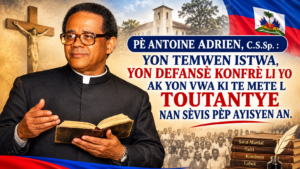
Dans le cadre de la réalisation du documentaire consacré au Père Antoine Adrien, C.S.Sp., premier directeur haïtien du Petit Séminaire Collège Saint-Martial et premier supérieur provincial haïtien de la Congrégation du Saint-Esprit pour le district d’Haïti, nous continuons d’avancer dans la bonne direction.
Cette œuvre de mémoire progresse grâce au soutien de nombreuses personnes de bonne volonté issues de notre communauté, ainsi que d’amis étrangers qui ont compris l’importance historique de ce projet et qui ont accepté d’y apporter leur précieuse contribution.
Ce documentaire entend faire revivre une page importante de l’histoire de l’Église catholique d’Haïti, particulièrement celle de la pastorale haïtienne, tant en Haïti que dans la diaspora.
Dans un texte en créole spécialement préparé pour ce documentaire, le Père William Smarth, historien et auteur d’un ouvrage en deux volumes consacré à l’histoire de l’Église catholique d’Haïti, a livré une réflexion particulièrement éloquente sur la personnalité du Père Antoine Adrien. Selon lui, pour véritablement connaître le Père Adrien, il fallait avoir vécu à ses côtés, tant Dieu l’avait comblé de richesses humaines et spirituelles qu’il aimait généreusement partager avec son prochain : au sein de sa famille, dans l’Église, au service de son pays et, tout particulièrement, auprès des pauvres.
Comme le souligne le Père William Smarth, le Père Antoine Adrien fut véritablement un trésor pour le peuple haïtien. Son témoignage de vie, sa fierté d’être Haïtien, son engagement ecclésial ainsi que les nombreux écrits qu’il nous a laissés constituent un héritage précieux qu’il nous appartient de préserver et de transmettre aux générations futures.
LE 15 AOÛT 1969 : UNE PAGE DOULOUREUSE DE L’HISTOIRE DE L’ÉGLISE D’HAÏTI
Avant de mettre davantage l’accent sur la vie et l’œuvre du regretté Père Antoine Adrien, je tiens à saluer, avec un profond respect, une grande affection et beaucoup de gratitude, la mémoire et le courage des neuf prêtres — cinq prêtres spiritains et quatre prêtres diocésains — expulsés d’Haïti le 15 août 1969 par le régime dictatorial de François Duvalier.
Je veux également rendre hommage au laïc engagé, l’économiste Pierre Cauvin, qui fut lui aussi contraint à l’exil, alors qu’il n’avait pourtant pris part à aucune des activités reprochées à ces prêtres.
Cet épisode demeure l’un des moments les plus douloureux de l’histoire contemporaine de l’Église catholique d’Haïti.
Selon les témoignages historiques rapportés à propos de cette affaire, le ministre des Cultes, René Chalmers, avait demandé à Mgr François-Wolff Ligondé, alors archevêque de Port-au-Prince, d’informer les prêtres concernés qu’ils étaient convoqués à une réunion à la chancellerie haïtienne, en début d’après-midi, le 15 août 1969.
Vers 13 h 30, le ministre Chalmers arriva, accompagné du secrétaire d’État Adrien Raymond. Il invita les prêtres et le laïc à entrer dans son bureau et à prendre place.
D’un ton particulièrement sévère et ferme, il leur déclara :
« On va vous lire le décret du gouvernement et je ne veux pas de questions. »
Il demanda ensuite à M. Massillon, fonctionnaire du département des Cultes, de donner lecture du décret gouvernemental qui les déclarait personae non gratae et leur ordonnait de quitter Haïti sans retourner chez eux pour prendre leurs effets personnels ni saluer leurs proches. Ils devaient embarquer, le jour même, à bord du prochain vol d’Air France à destination de Paris.
Le bureau du ministre Chalmers était rempli de Tontons Macoutes, qui observaient les personnes convoquées avec des regards menaçants et hostiles.
Aux environs de 15 heures, trois voitures, conduites par des officiers des Forces armées d’Haïti, vinrent chercher les prêtres et le laïc pour les conduire à l’aéroport international François-Duvalier, à Maïs-Gâté.
Le gouvernement Duvalier avait donné l’ordre de vider l’aéroport international François-Duvalier. Tous les billets des voyageurs prévus pour les vols de cet après-midi-là furent annulés, à l’exception de ceux de la mère du chef de la police, le colonel Arty, de sa fille et d’un garde du corps.
Les neuf prêtres et Pierre Cauvin furent escortés militairement jusqu’à leurs sièges dans l’avion. Ce n’est qu’à ce moment-là que leurs billets et leurs passeports, désormais valables uniquement pour la France, leur furent remis.
LES ACCUSATIONS DU RÉGIME ET LE CAS DU PÈRE MAX DOMINIQUE, C.S.Sp.
Dans une lettre adressée au supérieur général de la Congrégation du Saint-Esprit, le Père Joseph Lécuyer, C.S.Sp., le ministre René Chalmers formula de graves accusations contre les prêtres expulsés. Il leur reprochait notamment d’entretenir des alliances avec des partis politiques clandestins et de soutenir des idéologies qu’il présentait comme subversives de la foi et de la morale chrétiennes.
Le ministre évoqua également les prétendues activités procommunistes du Père Max Dominique, C.S.Sp. Il l’accusait notamment d’être le fondateur du journal de gauche Haïti Progrès et de servir d’agent de liaison auprès des communistes.
Au cours de l’année 1969, le régime de François Duvalier avait d’ailleurs convoqué le Père Max Dominique au département des Cultes pour un interrogatoire musclé portant sur ses relations présumées avec certains membres du Parti communiste. Cette convocation aurait eu lieu en présence de l’archevêque François-Wolff Ligondé et du nonce apostolique en Haïti, Mgr Luigi Barbarito, nommé le 10 juin 1969 par le pape Paul VI. L’objectif de cet interrogatoire était notamment de tenter d’établir que le Père Dominique lui-même était communiste.
Le Père Antoine Adrien était présent lors de cette rencontre afin de défendre son confrère. Ce geste témoigne de son courage, de sa solidarité sacerdotale et de son attachement à la justice, particulièrement lorsqu’un de ses confrères était injustement mis en accusation.
On peut difficilement imaginer la profonde tristesse et la révolte intérieure du jeune Père Max Dominique pendant le voyage qui le conduisait hors de son pays, le 15 août 1969.
Comme le rapporte le Père William Smarth dans son ouvrage Pages d’histoire de l’Église catholique d’Haïti, le Père Max Dominique était profondément meurtri. Bouleversé et indigné, il pleura durant tout le trajet de son voyage d’exil vers Paris. Il n’avait alors que 29 ans.
Aux yeux du régime de François Duvalier, il semblait porter une lourde responsabilité parce qu’il était considéré comme trop proche de certaines personnes opposées au pouvoir. Il était devenu, en quelque sorte, le bouc émissaire de cette affaire.
Un ancien élève du Petit Séminaire Collège Saint-Martial, proche du Père Max Dominique et qui souhaite conserver l’anonymat, m’a confié que ce dernier aurait pu sombrer dans une profonde détresse psychologique sans le soutien, la présence et le précieux accompagnement du Père Antoine Adrien.
Selon ce témoignage, le Père Dominique avait le sentiment que le gouvernement de Duvalier s’était largement servi de sa personne pour justifier l’expulsion collective du 15 août 1969.
Derrière les accusations politiques et les décisions administratives se trouvaient donc des hommes, des prêtres, des éducateurs et des serviteurs de l’Église, dont les vies allaient être profondément bouleversées par cette décision injuste et arbitraire.
LE PÈRE ANTOINE ADRIEN FACE À L’EXPULSION DE SES CONFRÈRES
Pour le Père Antoine Adrien, cette expulsion fut également un choc considérable.
Au moment où ces événements se déroulaient en Haïti, il se trouvait à Chevilly-Larue, près de Paris, où s’achevait le Chapitre général de la Congrégation du Saint-Esprit.
La nouvelle de l’expulsion de ses confrères le surprit profondément. Pour lui, une telle décision était incompréhensible et inacceptable. Il envisageait même de retourner en Haïti, malgré la situation politique particulièrement difficile.
Face à cette injustice, il ne resta pas silencieux. Accompagné du supérieur général des Spiritains, le Révérend Père Joseph Lécuyer, C.S.Sp., il se rendit à l’ambassade d’Haïti à Paris afin de protester contre l’expulsion de ses confrères et les mesures prises à son encontre, et d’exprimer ouvertement son opposition à cette décision dictatoriale et injuste du régime brutal de François Duvalier.
Ce geste mérite d’être souligné. Le Père Adrien ne défendait pas simplement des confrères religieux : il cherchait toujours à protéger des hommes, des serviteurs de Dieu et des citoyens haïtiens brutalement persécutés par le gouvernement de François Duvalier en raison de leurs convictions politiques réelles ou présumées.
Son engagement en faveur de la justice et de la dignité humaine allait également se manifester auprès des Haïtiens marginalisés aux États-Unis. Il incarnait ainsi une solidarité qui dépassait largement les liens de fraternité sacerdotale.
Après leur arrivée en France, le groupe des prêtres haïtiens fut progressivement dispersé. Les circonstances de l’exil imposèrent à chacun de reconstruire sa vie dans un contexte nouveau et souvent douloureux. Certains reprirent leurs études, d’autres cherchèrent un emploi, tandis que quelques-uns finirent par quitter le ministère sacerdotal pour donner une nouvelle orientation à leur existence.
Le 15 août 1969 ne fut donc pas seulement une date d’expulsion. Ce fut une rupture profonde dans la vie de plusieurs hommes, dans l’histoire de la Congrégation du Saint-Esprit en Haïti et dans celle de l’Église catholique haïtienne.
Le Père William Smarth, l’une des grandes figures de l’Église catholique d’Haïti et l’un des prêtres expulsés le 15 août 1969 par le régime de François Duvalier, retourna aux études à Rome, à l’Université pontificale grégorienne, dans la Ville éternelle. De leur côté, le Père Antoine Adrien et le Père Max Dominique furent envoyés en République centrafricaine pour enseigner au Petit Séminaire de Bangui.
À la fin de ses études, le Père William Smarth vint passer ses vacances d’été 1971 à New York afin de rendre visite aux membres de sa famille et de rencontrer quelques amis. Durant son séjour, il fut frappé par la croissance rapide de la communauté haïtienne, alimentée notamment par la vague de réfugiés qui débarquaient chaque jour sur les côtes de la Floride. Dans certaines paroisses de Brooklyn, les fidèles haïtiens devenaient de plus en plus nombreux.
Cependant, une difficulté majeure se posait : ces nouveaux arrivants ne parlaient pas anglais, tandis que les curés et les autres membres du clergé des paroisses de Brooklyn ne parlaient pas créole. Il devenait donc urgent de trouver des prêtres haïtiens capables d’accompagner spirituellement et pastoralement cette communauté grandissante.
De retour de ses vacances, le Père Smarth prit l’initiative d’écrire à son ami de longue date, le Père Antoine Adrien, alors en poste à Bangui, pour l’inviter à venir à New York afin de contribuer à l’accompagnement pastoral de la communauté haïtienne du diocèse de Brooklyn-Queens.
La réponse du Père Adrien ne se fit pas attendre. Avec une pointe d’humour et une certaine réserve, il répondit au Père Smarth qu’il n’avait jamais rêvé de venir exercer son ministère dans la capitale du monde capitaliste.
Parallèlement, Monseigneur Francis John Mugavero, cinquième évêque du diocèse de Brooklyn-Queens (1968-1990), avait entrepris des démarches auprès du supérieur général de la Congrégation du Saint-Esprit afin d’obtenir l’affectation de quelques prêtres haïtiens pour accompagner les fidèles haïtiens de son diocèse.
Le Père Joseph Lécuyer, C.S.Sp., alors supérieur général de la Congrégation, prit contact avec le Père Antoine Adrien. Celui-ci accepta finalement de répondre à cet appel missionnaire et de se rendre à New York.
Son départ de Bangui eut lieu dans un contexte particulièrement délicat, marqué par les tensions avec le président centrafricain Jean-Bédel Bokassa, après que le Père Max Dominique eut publiquement désavoué certaines de ses positions. Il fallait donc agir rapidement afin d’éviter que la situation ne s’aggrave et que le Père Max Dominique ne soit davantage exposé aux représailles du régime Bokassa.
Selon le Père Smarth, qui se trouvait déjà à New York depuis décembre 1971, le Père Adrien arriva dans cette ville au début du mois de janvier 1972.
Leur ami commun, le jeune Père Guy Sansaricq, qui les avait précédés, ne pouvait plus retourner en Haïti sous le régime de François Duvalier en raison de sa proximité avec les réfugiés haïtiens, dont il était devenu l’un des fervents défenseurs durant son ministère à Nassau, aux Bahamas. Cette impossibilité de retour était également liée au drame des vêpres de Jérémie, au cours duquel plusieurs membres de sa famille avaient été victimes des sbires du régime duvaliériste et des Tontons Macoutes. Il exerçait alors son ministère à la paroisse du Sacré-Cœur, située dans le Queens, au sein du diocèse de Brooklyn-Queens.
Le Père spiritain français Jean-Yves Urfié, C.S.Sp., arriva un mois plus tard. Selon M. Yves Raymond, ancien élève du Père Urfié au Petit Séminaire Collège Saint-Martial, ce dernier était responsable de la publication de la revue bimensuelle Sèl, ainsi que de l’organisation des activités culturelles et artistiques des Haitian Fathers.
Parlant couramment le créole, le Père Urfié avait enseigné la chimie et l’anglais au Petit Séminaire Collège Saint-Martial, en Haïti. Profondément attaché au peuple haïtien, il manifestait une grande proximité avec ses luttes et ses aspirations. Il comptait parmi les amis les plus fidèles et les plus dévoués du peuple haïtien.
Plusieurs amis et membres de la famille du Père Adrien lui suggéraient de fonder un collège sur le modèle du Petit Séminaire Collège Saint-Martial, dans un quartier aisé du Queens, où résidaient des familles haïtiennes ainsi que des membres d’autres communautés multiethniques disposant de moyens financiers et susceptibles d’apporter leur soutien à une telle institution.
Le Père Adrien s’y refusa catégoriquement. Il préférait rester avec les autres Haitian Fathers à Brooklyn, au milieu des Haïtiens marginalisés, souvent démunis et presque sans défense. Pour lui, ces personnes marginalisées étaient des icônes de Dieu.
Le Père Adrien ainsi que les Pères Smarth et Jean-Yves Urfié furent accueillis fraternellement par le Père Vincent Gallo, curé de la paroisse Our Lady of Good Counsel (Notre-Dame-du-Bon-Conseil), dans le quartier de Bedford-Stuyvesant, un endroit où vivaient des Américains noirs, des communautés latino-américaines de langue espagnole et quelques familles haïtiennes. Le Père Vincent était un Américain d’origine italienne.
Dans un premier temps, le Père Adrien et les deux autres prêtres, William Smarth et Jean-Yves Urfié, connus sous le nom de Haitian Fathers au sein du diocèse de Brooklyn-Queens, obtinrent l’autorisation du diocèse d’aller célébrer la messe dominicale dans les maisons des familles haïtiennes.
Bien vite, ils rencontrèrent le Père Roland Pierre, vicaire de la paroisse Sainte-Thérèse-d’Avila, qui disposait déjà d’une communauté haïtienne.
Ils commencèrent alors à se réunir chaque lundi après-midi pour préparer ensemble l’homélie du dimanche. Le jeune Père Guy Sansaricq participait presque toujours à ces rencontres.
Le mardi soir, ils rencontraient quelques laïcs afin de partager les nouvelles d’Haïti et de la communauté, particulièrement face à la vague de réfugiés haïtiens qui débarquaient chaque jour en grand nombre en Floride, préférant risquer leur vie sur des embarcations de fortune et devenir parfois la proie des requins plutôt que de continuer à vivre dans l’enfer de la dictature des Duvalier.
Ces rencontres permettaient également de préparer les chants et de choisir les laïcs appelés à jouer un rôle dans les célébrations dominicales à la paroisse Sainte-Thérèse-d’Avila.
C’est précisément dans cette paroisse que les Haitian Fathers, avec le Père Guy Sansaricq, prirent la décision de célébrer en créole l’ensemble des célébrations eucharistiques destinées à la communauté catholique haïtienne de Brooklyn-Queens.
Je dois ajouter que, selon l’ouvrage du Père William Smarth, Pages d’histoire de l’Église catholique d’Haïti, les Pères Rodrigue Auguste, Roland Pierre, Rollin Darbouze, Rulz Lubin et Paddy Proux, C.S.Sp., étaient déjà présents dans la région du Grand New York pour exercer leur ministère auprès de la communauté haïtienne et d’autres groupes ethniques. À ces confrères s’ajoutaient les Pères Carl Sansaricq et Joseph Darbouze, qui exerçaient leur ministère à Manhattan, ainsi que le Père Guy Sansaricq, qui travaillait dans le Queens et dans la région du Grand New York.
LES HAITIAN FATHERS : UNE PASTORALE AU SERVICE DE LA DIGNITÉ HUMAINE
Dès le début de leur ministère à Brooklyn, le Père Antoine Adrien et les autres Haitian Fathers — ou Pères haïtiens — comprirent l’importance d’offrir à leurs fidèles une solide formation spirituelle et humaine.
Ils voulaient les aider à sortir d’une conception de l’Évangile réduite à la résignation et à la consolation dans la souffrance. Ils leur proposaient plutôt une formation chrétienne qui les encourageait à questionner la société, le système et les mécanismes qui les reléguaient au bas de l’échelle sociale dans une société pluriethnique comme celle de New York.
La foi chrétienne ne devait pas être un instrument de soumission devant l’injustice, mais une force de libération, de prise de conscience et de transformation sociale.
La position courageuse du Père Adrien et des Haitian Fathers dans leur engagement auprès des réfugiés haïtiens nous encourage aujourd’hui à questionner notre propre foi en tant que chrétiens catholiques.
Elle nous invite également à réfléchir à l’attitude de certains de nos leaders spirituels qui n’hésitent pas à trinquer avec des bourreaux bien connus ou des criminels notoires ayant fait souffrir le peuple haïtien, en échange d’avantages personnels. Elle dénonce aussi cette tendance à voir systématiquement une démarche politique chaque fois qu’il s’agit de dénoncer une injustice, de condamner des structures injustes ou de prendre courageusement position contre des situations de péché.
La mission pastorale ne saurait se réduire à l’organisation de célébrations religieuses, de Jérichos, de pèlerinages, de réunions de prière, de « La Mer Rouge » ou encore à la multiplication des collectes de fonds. Elle exige également un engagement authentique et concret en faveur de la justice sociale, de la dignité humaine et de la défense des plus vulnérables.
L’Église ne peut prétendre servir les pauvres tout en fermant les yeux sur les mécanismes sociaux, économiques et politiques qui entretiennent leur pauvreté, leur exclusion et leur marginalisation. Annoncer l’Évangile, c’est aussi prendre position en faveur de ceux qui souffrent, dénoncer les injustices et travailler à la transformation des structures qui portent atteinte à la dignité humaine.
LA REVUE SÈL : UNE VOIX POUR INFORMER, ÉVEILLER ET FORMER LA COMMUNAUTÉ
Le Père Antoine Adrien et les autres prêtres haïtiens exilés, qui exerçaient leur ministère à Brooklyn, comprirent rapidement la nécessité de doter la communauté haïtienne d’un véritable outil de communication, d’information et de réflexion.
C’est ainsi que naquit en Avril 1972 la revue bimensuelle Sèl, rédigée en créole, un titre particulièrement évocateur, voire provocateur, dont la mission était d’informer la communauté haïtienne de la diaspora et de susciter une réflexion approfondie sur les grands problèmes auxquels elle était confrontée.
Selon l’ouvrage du Père Émile Jacquot, Les Spiritains en Haïti (1843-2003), le Père Antoine Adrien signait dans les pages de la revue Sèl une chronique très appréciée intitulée « Je Klere » (Les yeux ouverts). Dans cette chronique, il proposait une analyse particulièrement approfondie des problèmes d’Haïti, de la situation du peuple, des conditions de vie des plus pauvres et de leur exploitation à travers le continent américain. C’est ce qu’a rapporté le Père William Smarth, l’une des grandes figures intellectuelles de l’Église catholique d’Haïti.
Le Père Guy Sansaricq, qui allait devenir le premier évêque d’origine haïtienne de l’histoire de l’Église catholique aux États-Unis, figurait également parmi les collaborateurs et les écrivains de cette revue.
Cette expérience historique nous amène à poser une question qui mérite une profonde réflexion : pourquoi est-il si difficile, aujourd’hui, pour la pastorale haïtienne d’Amérique du Nord, qui compte plus d’une centaine de prêtres haïtiens, de se doter d’une publication de référence comparable à Sèl ?
Cette publication ne devait pas simplement transmettre des informations. Elle avait également pour vocation d’éveiller les consciences, de nourrir la réflexion et de contribuer à la formation intellectuelle, sociale, culturelle et spirituelle des Haïtiens de la diaspora.
La revue Sèl fut accueillie avec intérêt par plusieurs universités américaines, témoignant ainsi de la portée intellectuelle et de l’importance de cette initiative.
Comme l’a écrit le Père William Smarth dans son ouvrage Paj Istwa Legliz Katolik Ayiti (Pages d’histoire de l’Église catholique d’Haïti), Sœur Mechtilde Benoît, FDM, connue sous le nom de Sœur Josy, participait activement à la pastorale haïtienne, à la préparation de la revue Sèl, ainsi qu’aux rencontres du Père Antoine Adrien avec les autorités ecclésiastiques du diocèse de Brooklyn-Queens. Elle était également une figure très présente et appréciée à la paroisse Saint-Augustin.
Sœur Josy était la sœur du lieutenant François Benoît, dont la famille fut victime de la répression du régime de François Duvalier en avril 1963. Elle dut quitter précipitamment Haïti à la suite du drame au cours duquel elle perdit son père, sa mère et plusieurs autres membres de sa famille.
Elle partit d’abord exercer son ministère en Belgique avant de rejoindre Brooklyn, où elle poursuivit son engagement religieux et pastoral. Elle est connue comme la première religieuse haïtienne de la congrégation des Filles de Marie à avoir exercé son ministère à New York.
Selon le témoignage de Sœur Cecilia Duchaine, FDM, qui avait vécu avec elle à New York, Sœur Josy était une religieuse d’une grande sincérité, qui n’hésitait pas à exprimer franchement ses pensées. Elle était également très spirituelle, protectrice envers ses proches et profondément attachée à Haïti. D’une grande générosité, elle s’investissait pleinement dans la pastorale haïtienne de Brooklyn et témoignait d’un amour profond pour son peuple et son pays.
Son engagement, sa foi, sa générosité et son dévouement à la communauté haïtienne méritent d’être rappelés et transmis aux générations futures.
Que son âme repose en paix et que son témoignage demeure vivant dans nos mémoires.
LE PÈRE ANTOINE ADRIEN : UNE VIE CONSACRÉE AUX RÉFUGIÉS ET AUX PLUS VULNÉRABLES
La situation des Haïtiens vivant dans les quartiers pauvres de Brooklyn et de Floride allait transformer radicalement la vie du Père Antoine Adrien et celle des Haitian Fathers.
Ces prêtres allaient apprendre à vivre de l’essentiel. Leur ministère allait également les conduire à une profonde conversion pastorale et spirituelle. Le cri des réfugiés haïtiens les interpellait et les appelait à travailler pour l’avènement d’un ordre plus juste, d’un monde plus équitable et d’une société plus fraternelle.
Dans leur cœur résonnait également l’appel prophétique lancé par le pape Paul VI aux évêques d’Amérique latine, à la fin du concile Vatican II. Le Saint-Père rappelait que les supplications et les plaintes de tant d’hommes et de femmes vivant dans des conditions indignes ne pouvaient laisser l’Église indifférente. Il les exhortait à travailler à l’instauration d’un ordre social plus juste, dans lequel la justice sociale serait garantie à tous.
Le Père Antoine Adrien donna entièrement son cœur, son énergie et toute sa vie au service des réfugiés haïtiens au cours de son ministère à New York.
On pouvait l’appeler à n’importe quelle heure de la nuit pour venir au secours d’une sœur ou d’un frère réfugié de la communauté haïtienne. Il avait profondément compris que la souffrance des pauvres d’Haïti et de la diaspora constituait un affront à Jésus-Christ, mystérieusement présent dans leur existence.
Pour lui, servir les pauvres, ce n’était pas simplement leur apporter une aide matérielle ou leur offrir une consolation spirituelle. C’était reconnaître en chacun d’eux la présence du Christ et défendre leur droit à une vie digne.
UN VERSET BIBLIQUE POUR COMPRENDRE L’HÉRITAGE DU PÈRE ANTOINE ADRIEN
Le témoignage du Père Antoine Adrien trouve un écho particulier dans les paroles de Jésus-Christ rapportées dans l’Évangile selon saint Matthieu :
« Chaque fois que vous l’avez fait à l’un de ces plus petits de mes frères, c’est à moi que vous l’avez fait. »
— Matthieu 25, 40.
Ce verset résume admirablement la dimension évangélique de son engagement. Le Père Antoine Adrien avait compris que le Christ ne se rencontre pas uniquement dans les églises, les cérémonies liturgiques ou les discours religieux. Il se révèle également dans le visage de l’étranger, du réfugié, du pauvre, du persécuté et de toute personne privée de sa dignité.
Son ministère auprès des Haïtiens marginalisés de Brooklyn fut ainsi une véritable mise en pratique de l’Évangile. Il ne s’était pas contenté de prêcher la Bonne Nouvelle : il avait choisi de la vivre au milieu de ceux qui avaient le plus besoin de solidarité, de compassion et de justice.
UN HÉRITAGE À TRANSMETTRE AUX GÉNÉRATIONS FUTURES
À travers ce documentaire, nous ne voulons pas simplement raconter la vie d’un ancien directeur du Petit Séminaire Collège Saint-Martial, d’un religieux spiritain ou d’un prêtre haïtien ayant exercé son ministère aux États-Unis.
Nous voulons surtout faire découvrir un homme de conviction, un éducateur, un intellectuel, un pasteur engagé et un défenseur de la dignité humaine. Un homme qui, face à la persécution, n’a pas abandonné ses confrères ; face à la dictature, n’a pas renoncé à ses convictions ; face à la souffrance des réfugiés, n’a pas détourné le regard.
Le Père Antoine Adrien nous rappelle qu’un véritable pasteur ne peut rester indifférent aux souffrances de son peuple. Il nous enseigne que la foi chrétienne doit nécessairement se traduire par des actes de solidarité, de justice, de courage et de fraternité.
Son choix de rester aux côtés des Haïtiens les plus vulnérables de Brooklyn, plutôt que de privilégier un ministère plus confortable auprès des familles aisées, constitue l’une des plus belles illustrations de sa conception de la mission sacerdotale.
Aujourd’hui, alors que notre pays traverse encore de profondes crises politiques, sociales, économiques et humaines, et que des milliers de nos compatriotes continuent de chercher refuge ailleurs, le témoignage du Père Antoine Adrien demeure d’une actualité saisissante.
Son histoire interpelle notre conscience collective. Elle nous invite à nous demander quel type d’Église nous voulons construire, quelle place nous réservons aux pauvres dans nos communautés et jusqu’où nous sommes prêts à aller pour défendre la vérité, la justice et la dignité humaine.
Ce documentaire est donc bien plus qu’un projet audiovisuel. C’est un devoir de mémoire, un acte de reconnaissance et un engagement envers les générations futures. Nous avons la responsabilité de préserver cette mémoire, de recueillir les témoignages de ceux qui l’ont connu et de transmettre aux jeunes générations les valeurs humaines, spirituelles et patriotiques qui ont marqué son existence.
Nous espérons que cette œuvre contribuera à faire connaître davantage le Père Antoine Adrien, C.S.Sp., en Haïti, dans la diaspora et au sein de l’Église universelle.
Que son exemple continue d’inspirer les prêtres, les religieux, les religieuses, les laïcs engagés, les éducateurs et tous ceux qui croient qu’une société plus juste et plus fraternelle est possible.
Le Père Antoine Adrien a quitté cette terre, mais son témoignage demeure. Sa voix s’est tue, mais son engagement continue de nous parler. Son héritage appartient désormais à l’histoire et à la conscience du peuple haïtien.
Que Dieu accueille son serviteur fidèle dans sa paix et que son témoignage continue d’éclairer notre chemin.
Frère Buteau (Brother Tob)
Radio Télé Solidarité de New York
Téléphone : 631-214-6241
Courriel : radiotelesolidarite@gmail.com
PÈ ANTOINE ADRIEN, C.S.Sp. : YON TEMWEN ISTWA, YON DEFANSÈ KONFRÈ LI YO AK YON VWA KI TE METE L TOUTANTYE NAN SÈVIS PÈP AYISYEN AN.
Nan kad reyalizasyon dokimantè nou ap prepare sou lavi ak travay Pè Antoine Adrien, C.S.Sp., premye Ayisyen ki te dirije Ti Seminè Kolèj Sen Masyal, Ayiti epi premye siperyè pwovensyal Ayisyen nan Kongregasyon Lespri Sen pou distri Ayiti a, nou kontinye vanse nan bon direksyon .
Travay memwa sa a ap pwogrese gras ak sipò anpil moun ki gen bon volonte e ki renmen kominote nou an, ansanm ak zanmi etranje ki konprann enpòtans istorik pwojè sa epi ki dakò pote kontribisyon pa yo.
Dokimantè sa a gen pou objektif fè nou reviv yon paj enpòtan nan istwa Legliz Katolik Ayiti , sitou istwa Pastoral ayisyen an, ni ann Ayiti ni nan dyaspora a.
Nan yon tèks an kreyòl li prepare espesyalman pou dokimantè sa , Pè William Smarth, istoryen epi otè yon liv ki gen de (2) volim sou istwa Legliz Katolik Ayiti , fè yon refleksyon ki chaje ak sans sou pèsonalite Pè Antoine Adrien. Dapre li, pou yon moun te rive konnen Pè Adrien toutbon, fòk li te viv bò kote l, paske Bondye te vide anpil Gras ak richès imen nan lavi li, e li te renmen pataje richès sa yo ak pwochen li san rezèv: nan fanmi li, nan Legliz la, nan sèvis peyi li Ayiti , e sitou nan sèvis pòv yo oswa pi piti yo.
Pou Pè William Smarth , Pè Antoine Adrien te vrèman yon trezò pou pèp ayisyen an. Temwayaj lavi li, fyète li Kòm Ayisyen, angajman li nan Legliz la, ansanm ak tout ekriti li kite pou nou yo, se yon eritaj ki gen anpil valè. Se devwa nou pou nou prezève eritaj sa a epi transmèt li bay jenerasyon k ap vini yo.
15 OUT 1969 : YON PAJ KI CHAJE AK DOULÈ NAN ISTWA LEGLIZ AYITI A
Anvan mwen mete plis aksan sou lavi ak travay defen Pè Antoine Adrien, mwen vle salye, avèk anpil respè, anpil afeksyon ak anpil rekonesans, memwa ak kouraj nèf (9) prèt yo — senk (5) prèt spiriten ak kat (4) prèt dyosezen — rejim diktatè François Duvalier a te mete deyò nan peyi d Ayiti nan dat 15 out 1969 .
Mwen vle rann omaj tou ak yon layik angaje, ekonomis Pierre Cauvin, yo te oblije pran egzil li menm tou, alòske li pa t patisipe nan okenn nan aktivite yo te repwoche prèt sa yo.
Evènman sa a rete youn nan moman ki pi douloure nan istwa resan Legliz Katolik Ayiti a.
Dapre temwayaj istorik ki rapòte sou dosye sa a, minis Kilt Ayiti nan moman sa, René Chalmers, te mande Monseyè François-Wolff Ligondé, ki te achevèk Pòtoprens nan epòk la, pou l fè prèt konsène yo konnen yo te konvoke yo nan yon reyinyon nan Chanselri Ayiti a, nan kòmansman apremidi 15 out 1969 la.
Vè 1è edmi nan apremidi, minis René Chalmers te rive ansanm ak sekretè deta Adrien Raymond. Li envite prèt yo ak layik la antre nan biwo li epi pran plas yo.
Avèk yon ton ki te di anpil, ki te montre severite ak fèmte, li deklare :
« Yo pral li dekrè gouvènman an pou nou, e mwen pa vle okenn kesyon. »
Apre sa, li mande Mesye Massillon, yon fonksyonè nan Depatman Kilt yo, pou l li dekrè gouvènman an ki te deklare yo personae non gratae oswa Pè say o ak Pierre Cauvin pap kapab viv nan peyi Ayiti ankò., sa vle di rejim Divalye a nan pa t vle wè Kamokin sa yo nan peyi Ayiti, epi ki te ba yo lòd pou yo kite Ayiti san yo pa t gen dwa retounen lakay yo pou pran afè pèsonèl yo ni di fanmi yo ak Zanmi yo orevwa. Yo te dwe pran premye vòl Air France ki t ap pati pou Pari menm jou a.
Biwo minis Chalmers la te chaje ak Tonton Makout ki t ap siveye Ayisyen sa yo ki te konvoke yo avèk je menasan ak ostilite.
Vè 3è nan apremidi, twa machin, ofisye Fòs Ame d Ayiti yo t ap kondi, vin chèche prèt yo ak layik la pou mennen yo nan Ayewopò Entènasyonal François-Duvalier, nan Maïs-Gâté.
Gouvènman Duvalier a te bay lòd pou yo vide Ayewopò Entènasyonal François-Duvalier a. Yo te anile tout tikè moun ki te gen vòl pou apremidi sa , eksepte tikè manman chèf polis la, kolonèl Arty, pitit fi li ak yon gad kò fanmi sa.
Yo te eskòte nèf prèt yo ak Pierre Cauvin anba gwo siveyans militè pou mennen yo rive nan plas yo nan avyon an. Se sèlman nan moman sa a yo te remèt yo tikè yo ak paspò yo, ki te vin valab sèlman pou Lafrans.
AKIZASYON REJIM NAN AK DOSYE PÈ MAX DOMINIQUE, C.S.Sp.
Nan yon lèt li te voye bay siperyè jeneral Kongregasyon Lespri Sen an, Pè Joseph Lécuyer, C.S.Sp., minis René Chalmers te fè gwo akizasyon kont prèt yo te mete deyò yo. Pami lòt bagay, li te repwoche yo paske yo t ap fè alyans ak kèk pati politik klandesten epi paske yo t ap soutni ideyoloji li te prezante kòm lide ki t ap mine lafwa ak moral kretyen yo.
Minis la te pale tou sou swadizan aktivite pwo-kominis Pè Max Dominique, C.S.Sp. Li te akize l, sitou, kòmkwa se li ki te fonde jounal gochis Haïti Progrès la epi li t ap sèvi kòm ajan lyezon ak kominis yo.
Pandan ane 1969 la, rejim François Duvalier a te konvoke Pè Max Dominique nan Depatman Kilt Ayiti a pou yon entèwogatwa ki te fèt avèk anpil presyon sou swadizan relasyon li te genyen ak kèk manm Pati Kominis la. Dapre sa yo rapòte, entèwogatwa sa a te fèt nan prezans achevèk François-Wolff Ligondé ak nonse apostolik Ayiti a, Monseyè Luigi Barbarito, Pap Pòl VI te nonmen nan pòs sa a nan dat 10 jen 1969. Youn nan objektif entèwogatwa a se te eseye pwouve Pè Dominique li menm te yon kominis.
Pè Antoine Adrien te prezan nan rankont sa a pou l te defann konfrè li. Jès sa a montre kouraj li, solidarite li ant prèt yo ak atachman li pou jistis, sitou lè youn nan konfrè li yo te viktim akizasyon ki pa t jis.
Li difisil pou nou imajine gwo tristès ak gwo revolte ki te nan kè jèn Pè Max Dominique pandan vwayaj ki t ap mennen l kite peyi li nan dat 15 out 1969 la.
Jan Pè William Smarth rakonte sa nan liv li a, Kek Pag Istwa Legliz Katolik Ayiti d’Haïti, Pè Max Dominique te blese anpil nan fon kè li. Li te boulvèse, li te endiye, epi li te pase tout vwayaj pou egzil sa pou Pari ap kriye. Lè sa a, li te gen sèlman 29 an oswa 29 Rekot Kafe.
Nan je rejim François Duvalier a, li te sanble se Pè Max menm ki te pote yon gwo responsablite, paske yo te konsidere l kòm yon Pè ki te twò pwòch ak kèk moun ki te opoze ak pouvwa Boutdi Fwanswa Divalye a . Konsa, nan yon sans, yo te fè l tounen bouk emisè nan dosye sa .
Yon ansyen elèv Ti Seminè Kolèj Sen Masyal Ayiti , ki te pwòch Pè Max Dominique e ki swete nou pa site non li , te fè m konnen Pè Dominique te kapab tonbe nan yon gwo detrès sikolojik oswa li te kabab fou si li pa t jwenn sipò, prezans ak akonpayman espesyal Pè Antoine Adrien ki te jwe wol yon papa pou li nan moman sa.
Dapre temwayaj sa , Pè Dominique te santi gouvènman Duvalier a te sèvi ak non li ak pèsonalite li anpil pou jistifye ekspilsyon kolektif 15 out 1969 la.
Dèyè akizasyon politik sa yo ak desizyon administratif sa yo, te gen moun, prèt, edikatè ak sèvitè Legliz la, ki t apral wè lavi yo boulvèse nèt akoz yon desizyon ki te enjis e abitrè.
PÈ ANTOINE ADRIEN DEVAN EKSPILSYON KONFRÈ LI YO
Pou Pè Antoine Adrien, ekspilsyon sa a te yon gwo chòk tou.
Lè evènman sa yo t ap dewoule ann Ayiti, Pè Antoine Adrien te nan Chevilly-Larue, toupre Pari, kote Chapit jeneral Kongregasyon Lespri Sen an t ap fini.
Nouvèl ki te anonse yo te mete konfrè li yo deyò nan peyi a te fè li sezi l anpil. Pou li, yon desizyon konsa pa t gen okenn sans e li pa t akseptab. Li te menm anvizaje retounen ann Ayiti, malgre sitiyasyon politik la te difisil anpil.
Devan enjistis sa a, Pè Adrien pat te rete dyol fèmen. Li te akonpaye siperyè jeneral Spiriten yo, Reveran Pè Joseph Lécuyer, C.S.Sp., pou li te ale nan Anbasad Ayiti nan Pari (Frans) pou pwoteste kont ekspilsyon konfrè li yo ak mezi yo te pran kont li menm tou, epi pou l te eksprime klèman opozisyon li kont desizyon diktatoryal ak enjis rejim brital François Duvalier a.
Jès sa a merite pou nou souliye l. Pè Adrien pa t sèlman ap defann kèk konfrè relijye oswa Pè; li te toujou ap chèche pwoteje moun, sèvitè Bondye ak sitwayen ayisyen gouvènman François Duvalier a t ap pèsekite akoz opinyon politik yo, kit opinyon sa yo te reyèl, kit se te swadizan opinyon yo te genyen.
Angajman li nan defans jistis ak diyite moun t apral parèt tou nan fason li te kanpe bò kote Ayisyen yo te mete sou kote Ozetazini. Konsa, solidarite li te depase anpil limit fratènite ant prèt yo.
Apre prèt yo te rive an Frans, yo te kòmanse separe yo piti piti. Sitiyasyon egzil la te oblije chak moun rebati lavi yo nan yon nouvo anviwònman, ki pa t fasil e ki te souvan chaje ak gwo doulè. Genyen ki te reprann etid yo oswa retounen Lekol , gen lòt ki te al chèche travay, pandan kèk ladan yo te fini pa kite ministè prèt la pou yo te bay lavi yo yon lòt direksyon.
Se poutèt sa, 15 out 1969 la pa t sèlman yon dat yo te mete kèk moun deyò nan peyi a. Se te yon gwo kastèt nan lavi plizyè moun, nan istwa Kongregasyon Spiriten yo an Ayiti ak nan istwa Legliz Katolik Ayiti a.
Pè William Smarth, youn nan gwo pèsonalite Legliz Katolik Ayiti a epi youn nan prèt rejim François Duvalier a te mete deyò nan dat 15 out 1969 la, te retounen sou ban lekòl nan Wòm, nan Inivèsite Pontifikal Gregoryèn, nan Vil Etènèl la. Bò kote pa yo, Pè Antoine Adrien ak Pè Max Dominique te ale nan Repiblik Afrik Santral pou yo te anseye nan Ti Seminè Bangui.
Lè Pè William Smarth te fini etid li yo, li te vin pase vakans ete 1971 an Nouyòk pou l te ka vizite manm fanmi li epi rankontre kèk zanmi. Pandan sejou li a, li te sezi wè jan kominote ayisyen an t ap grandi byen vit. Kwasans sa a te gen anpil rapò ak vag refijye ayisyen ki t ap debake chak jou pi plis sou kòt Florid yo. Nan kèk pawas nan Brooklyn, kantite fidèl ayisyen yo t ap ogmante chak jou.
Sepandan, te gen yon gwo pwoblèm: nouvo imigran sa yo pa t pale angle, tandiske pè kire yo ak lòt manm klèje pawas Brooklyn yo pa t pale kreyòl. Se poutèt sa, li te vin yon gwo ijans pou yo jwenn prèt ayisyen ki te kapab akonpaye kominote Ayisyen sa a sou plan espirityèl ak pastoral.
Lè Pè Smarth te retounen sot nan vakans , li te pran inisyativ pou l ekri ansyen zanmi li e frè li, Pè Antoine Adrien, ki tap travay nan Bangui nan epòk la, pou envite l vin Nouyòk pou l te patisipe nan akonpayman pastoral kominote ayisyen an nan Dyosèz Brooklyn-Queens la.
Pè Adrien pa t pran tan pou l reponn .Avèk yon ti souri anba moustach li men tou ak anpil prekosyon, li reponn Pè Smarth li pa t janm wè tèt li nan rèv li ap vin fè travay Bondye nan kè peyi kapitalis la.
Anmenmtan, Monseyè Francis John Mugavero, senkyèm evèk Dyosèz Brooklyn-Queens la (1968-1990), te deja kòmanse fè demach bò kote siperyè jeneral Kongregasyon Lespri Sen an pou l te jwenn kèk prèt ayisyen pou akonpaye fidèl ayisyen ki te nan dyosèz li a.
Pè Joseph Lécuyer, C.S.Sp., ki te siperyè jeneral Kongregasyon an nan epòk la, te pran kontak ak Pè Antoine Adrien. Finalman, Pè Adrien te aksepte reponn apèl misyonè sa a epi ale Nouyòk.
Li te kite Bangui nan yon moman ki te delika anpil, paske te gen tansyon ak prezidan Repiblik Afrik Santral la, Jean-Bédel Bokassa, apre Pè Max Dominique te fin deklare piblikman li pa t dakò ak kèk nan pozisyon prezidan an. Se poutèt sa, yo te bezwen kite Bangui vit pou sitiyasyon an pa t vin pi grav epi pou Pè Max Dominique pa t vin plis ekspoze anba represay rejim Bokassa a.
Dapre Pè Smarth, ki te deja Nouyòk depi desanm 1971, Pè Adrien te rive nan vil Nouyòk a nan kòmansman mwa janvye 1972.
Zanmi yo te genyen an komen an, Pè Guy Sansaricq (Pè Guy), ki te rive anvan yo, pa t kapab retounen ann Ayiti ankò sou rejim François Duvalier a akoz relasyon sere li te genyen ak refijye ayisyen yo, li menm ki te vin youn nan pi gwo defansè yo pandan ministè li nan Nassau, nan Bahamas. Enposiblite pou l te retounen ann Ayiti a te gen rapò tou ak trajedi Vèp Jeremi an, kote plizyè manm fanmi li te viktim anba men sbir rejim duvalyeris la ak Tonton Makout yo. Nan epòk sa a, li t ap egzèse ministè li nan pawas Sacré-Cœur la, nan Queens, nan Dyosèz Brooklyn-Queens la.
Pè spiriten fransè Jean-Yves Urfié, C.S.Sp., te rive yon mwa apre. Dapre Mesye Yves Raymond, ki te yon ansyen elèv Pè Urfié nan Ti Seminè Kolèj Sen Masyal , li te di m se Pè Urfié ki te responsab piblikasyon jounal Sèl chak de semèn , ansanm ak òganizasyon aktivite kiltirèl ak atistik Haitian Fathers yo.
Pè Urfié te pale kreyòl tankou rat . Li te anseye chimi ak anglè nan Ti Seminè Kolèj Sen Masyal (Petit Séminaire Collège Saint-Martial) ann Ayiti. Li te gen yon gwo atachman ak anpil lanmou pou pèp ayisyen an, e li te toujou montre anpil solidarite nan lit pèp Ayisyen an. Li te pami zanmi ki te toujou fidèl e ki te pi devwe anvè pèp ayisyen an.
Plizyè zanmi ak manm fanmi Pè Adrien te konseye l lè fèt rive Brooklyn pou l te fonde yon kolèj sou modèl Ti Seminè Kolèj Sen Masyal (Petit Séminaire Collège Saint-Martial) la, nan yon katye nan Queens, kote te gen fanmi ayisyen ansanm ak moun ki soti nan lòt kominote miltietnik ki te gen gwo mwayen finansye e ki te kapab pote sipò pou yon enstitisyon konsa.
Pè Adrien te refize lide sa kategorikman. Li te pito rete ansanm ak lòt Haitian Fathers yo nan Brooklyn, nan mitan Ayisyen yo te mete sou kote yo , ki te souvan nan mizè e , ki pa gen Papye legal pou viv ozetazini e ki prèske pa t gen okenn moun pou defann yo. Pou li, Ayisyen sa yo sosyete a te mete sou kote se te ikon Bondye.
Pè Adrien ansanm ak Pè Smarth ak Pè Jean-Yves Urfié te jwenn yon bèl akèy fratènèl nan men Pè Vincent Gallo, kire pawas Our Lady of Good Counsel (Notre-Dame-du-Bon-Conseil), nan katye Bedford-Stuyvesant. Se te yon zòn kote te gen Ameriken nwa, kominote latino-ameriken ki pale panyòl ak kèk fanmi ayisyen. Pè Vincent te yon Ameriken ki te gen orijin italyen.
Nan premye etap ministè yo a, Pè Adrien ak de lòt prèt yo, William Smarth ak Jean-Yves Urfié, yo te konnen sou non Haitian Fathers nan Dyosèz Brooklyn-Queens la, te jwenn otorizasyon dyosèz la pou yo te al selebre lamès dimanch nan kay fanmi ayisyen yo.
Byen vit, yo te rankontre Pè Roland Pierre, vikè pawas Sainte-Thérèse-d’Avila a, ki te deja gen yon kominote ayisyen.
Yo te kòmanse reyini chak lendi aprèmidi pou prepare ansanm omeli dimanch lan. Pè Guy Sansaricq te toujou patisipe nan rankont sa yo.
Nan madi swa, yo te konn rankontre kèk layik pou pataje nouvèl ki soti ann Ayiti ak nouvèl kominote a, sitou nan yon moman anpil refijye ayisyen yo t ap debake an kantite chak jou nan Florid. Moun sa yo te prefere riske lavi yo sou ti bato ki pa t solid, kote pafwa reken te ka devore yo, olye yo kontinye viv nan lanfè diktati Duvalier yo.
Rankont sa yo te sèvi tou pou prepare chan yo epi chwazi layik ki t ap gen responsablite nan selebrasyon dimanch yo nan pawas Sainte-Thérèse-d’Avila a.
Se nan pawas sa a menm Haitian Fathers yo, ansanm ak Pè Guy Sansaricq, te pran desizyon pou yo selebre tout lamès ak lòt selebrasyon ekaristik pou kominote katolik ayisyen Brooklyn-Queens la an kreyòl.
Mwen dwe ajoute, dapre liv Pè William Smarth la, Kek pag Istwa Legliz Katolik Ayiti ( Pages d’histoire de l’Église catholique d’Haïti), Pè Rodrigue Auguste, Roland Pierre, Rollin Darbouze, Rulz Lubin ak Paddy Proux, C.S.Sp., te deja nan rejyon Gran Nouyòk la pou yo te egzèse ministè yo kòm Pè bò kote kominote ayisyen an ak lòt gwoup etnik yo. Te gen tou Pè Carl Sansaricq ak Joseph Darbouze, ki t ap egzèse ministè yo nan Manhattan, ansanm ak Pè Guy Sansaricq, ki t ap travay nan Queens ak nan rejyon Gran Nouyòk la.
HAITIAN FATHERS YO : YON APOSTOLA KI TE METE DIYITE MOUN NAN NAN SANT MISYON LI
Depi nan kòmansman ministè yo nan Brooklyn, Pè Antoine Adrien ak lòt Haitian Fathers yo, sa vle di Pè Ayisyen yo, te konprann enpòtans pou yo te bay fidèl yo yon fòmasyon espirityèl ak imen ki solid.
Yo te vle ede fidèl yo soti nan yon fason yo te konn konprann Levanjil la sèlman kòm yon mesaj ki mande moun aksepte soufrans yo san yo pa poze kesyon, epi jwenn konsolasyon nan mizè yo. Olye de sa, yo te pwopoze yo yon fòmasyon kretyen ki ankouraje yo poze kesyon sou sosyete a, sou sistèm nan ak sou mekanis ki t ap mete yo anba nechèl sosyal la nan yon sosyete ki gen anpil gwoup etnik tankou Nouyòk.
Lafwa kretyen an pa t dwe sèvi kòm yon zouti pou fè moun soumèt devan enjistis, men li te dwe tounen yon fòs liberasyon, yon mwayen pou ede moun pran konsyans epi transfòme sosyete a.
Pozisyon djann sa Pè Adrien ak Haitian Fathers yo te pran nan angajman yo bò kote refijye ayisyen yo ankouraje nou jodi a poze tèt nou kesyon sou pwòp lafwa nou antanke kretyen katolik.
Sa envite nou tou reflechi tou sou konpòtman kèk nan lidè espirityèl nou yo ki pa ezite leve vè ak moun tout moun konnen ki fè gwo zak mechanste, oswa gwo kriminèl ki fè pèp ayisyen an soufri, pou yo ka jwenn avantaj pèsonèl. Sa pouse nou denonse tandans kèk lidè nou yo genyen pou yo fè nou wè se yon demach politik chak fwa yon moun ap denonse enjistis, kondane estrikti enjis oswa pran pozisyon avèk kouraj kont sitiyasyon ki chaje ak peche. Ki kote misyon pwofetik Legliz la ye, li menm ki gen kòm misyon pou denonse tout estrikti enjistis ki egziste nan sosyete nou an? Èske Legliz la pa gen devwa pou l leve vwa li lè dwa moun ap vyole, lè pòv yo ap sibi enjistis, epi lè diyite moun pa respekte? Ki jan Legliz la kapab rete fidèl ak Levanjil Jezikri a si li chwazi fè silans devan enjistis, koripsyon, opresyon ak abi pouvwa? Nan yon sosyete kote inegalite ak enjistis ap vale teren, èske Legliz la pa dwe tounen yon vwa pou sila yo ki pa gen vwa, yon defansè pou moun y ap maltrete, ak yon limyè k ap montre chemen jistis, verite ak lapè?
Misyon pastoral la pa kapab limite sèlman ak òganizasyon selebrasyon relijye, tankou Jeriko, pelerinaj, reyinyon lapriyè, lòt aktivite tankou « Lanmè Wouj » oswa tou okasyon bon pou yon mande Pèp Lajan sou do legliz la (miltiplikasyon koleksyon lajan). Li mande tou yon angajman toutbon, konkrè, nan defans jistis sosyal, diyite moun ak moun ki pi vilnerab yo.
Legliz la pa kapab pretann l ap sèvi pòv yo pandan l ap fèmen je l sou mekanis sosyal, ekonomik ak politik ki kontinye kenbe yo nan povrete, eksklizyon ak majinalizasyon. Anonse Levanjil la vle di tou pran pozisyon pou moun k ap soufri, denonse enjistis epi travay pou transfòme estrikti ki vyole diyite moun.
JOUNAL SÈL : YON VWA POU ENFÒME, REVEYE KONSYANS AK FÒME KOMINOTE A
Pè Antoine Adrien ak lòt prèt ayisyen ki te an egzil e ki t ap egzèse ministè yo nan Brooklyn te konprann byen vit nesesite pou kominote ayisyen an te genyen yon bon zouti kominikasyon, enfòmasyon ak refleksyon.
Se konsa, nan mwa avril 1972, jounal Sèl ki sòti chak de semèn te parèt. Se te yon piblikasyon ki te ekri an kreyòl, ak yon tit ki te chaje ak sans, e ki te menm gen yon ti karaktè pwovokatè. Misyon li se te enfòme kominote ayisyen nan dyaspora a epi ankouraje yon refleksyon apwofondi sou gwo pwoblèm kominote sa a t ap konfwonte.
Dapre liv Pè Émile Jacquot la, Les Spiritains en Haïti (1843-2003), Pè Antoine Adrien te konn ekri yon kronik ki te trè apresye nan paj jounal Sèl la. Kronik sa a te rele « Je Klere » (Je nou louvri). Nan kronik sa a, li te konn fè yon analiz apwofondi sou pwoblèm Ayiti, sitiyasyon pèp la, kondisyon lavi moun ki pi pòv yo ak eksplwatasyon yo t ap sibi atravè kontinan ameriken an. Se sa Pè William Smarth, youn nan gwo pèsonalite entelektyèl Legliz Katolik Ayiti a, te rapòte nan liv Pè Émile Jacquot la, Les Spiritains en Haïti (1843-2003 .
Pè Guy Sansaricq, ki t apral vin premye evèk nan istwa Legliz Katolik Ozetazini ki se youn nan bon ayisyen nan tan pa nou an , te pami moun ki te kolabore ak jounal sa a e li te pibliye atik ladan l. Li te konprann Impotans jounal sa ki te ede anpil Kominote Ayisyen an e ki te ede yo dekouvri lòt fas Kache Etazini.
Eksperyans istorik sa a fè nou poze yon kesyon ki merite anpil refleksyon : Poukisa jodi a li tèlman difisil pou apostola ayisyen nan Amerik di Nò, ki gen plis pase yon santèn prèt ayisyen, paka mete sou pye yon piblikasyon referans ki sanble ak Sèl?
Piblikasyon sa a pa t la sèlman pou transmèt enfòmasyon. Li te gen misyon tou pou reveye konsyans moun, nouri refleksyon yo epi kontribye nan fòmasyon entelektyèl, sosyal, kiltirèl ak espirityèl Ayisyen ki nan dyaspora a.
Plizyè inivèsite ameriken te resevwa jounal Sèl la avèk anpil enterè. Sa montre enpòtans entelektyèl ak gwo valè inisyativ sa a te genyen.
Jan Pè William Smarth te ekri sa nan liv li a, Paj Istwa Legliz Katolik Ayiti, Sè Mechtilde Benoît, FDM, moun te konnen sou non Sè Josy, te patisipe aktivman nan apostola ayisyen an, nan preparasyon jounal Sèl la, li te konn patisipe nan rankont Pè Antoine Adrien te konn fè ak otorite eklezyastik Dyosèz Brooklyn-Queens yo. Li te trè visib nan pawas Saint-Augustin tou ki nan Brooklyn .
Sè Josy se te sè lyetnan François Benoît, fanmi li te viktim anba represyon rejim François Duvalier a nan mwa avril 1963. Li te oblije chape poul li kite Ayiti prese prese apre trajedi sa kote li te pèdi papa li, manman li ak plizyè lòt manm fanmi li nan masak Divalye te f è sou Fanmi li.
Li te ale vit nan peyi Bèljik pou l te egzèse ministè li kòm Sè relijyez nan kongregasyon Fiy Mari yo, anvan li te vin Brooklyn, kote li te kontinye angajman relijye ak pastoral li kòm sè relijyez Fiy Mari. Yo konnen li kòm premye relijyez ayisyèn nan kongregasyon Fiy Mari yo ki te vin egzèse ministè li nan lakou Nouyòk.
Dapre temwayaj Sè Cecilia Duchaine, FDM, ki te viv ansanm avè l nan Nouyòk, Sè Josy te yon S`e relijyez ki te gen anpil senserite, ki pa t jan m ezite di sa l te panse aklè. Li te yon Sè ki te trè espirityèl, ki te rinmen pwoteje moun ki te pwòch li epi ki te gen yon gwo Lanmou nan Kè li pou Ayiti. Li te trè jenere, li te angaje l ak tout fòs li nan apostola ayisyen Brooklyn nan epi li te toujou montre yon gwo lanmou nan kè li pou pèp li ak peyi li Ayiti.
Angajman li, lafwa li, jenerozite li ak devouman li pou kominote ayisyen an merite pou nou sonje li epi transmèt yo bay jenerasyon k ap vini yo.
Se pou nanm li repoze anpè, epi se pou temwayaj li rete vivan nan memwa nou.
PÈ ANTOINE ADRIEN : YON LAVI LI TE KONSACRE POU REFIJYE YO AK MOUN KI PI VILNERAB YO
Sitiyasyon Ayisyen ki t ap viv nan katye pòv Brooklyn yo ak nan Florid ta pral chanje lavi Pè Antoine Adrien ak lòt Haitian Fathers yo nèt.
Prèt sa yo ta pral aprann viv ak sa ki esansyèl . Ministè yo ta pral mennen yo tou nan yon gwo konvèsyon pastoral ak espirityèl. Kri refijye ayisyen yo t ap souke konsyans yo epi rele yo pou yo travay pou rive tabli yon lòd ki pi jis, yon mond ki pi ekitab ak yon sosyete kote moun ka viv tankou frè ak sè.
Nan kè yo, yo te tande tou apèl pwofetik Pap Pòl VI te lanse bay evèk Amerik Latin yo nan fen Konsil Vatikan II a. Sen Pè Paul VI te raple yo lapriyè, rèl ak plent anpil gason ak fi k ap viv nan kondisyon ki pa diy pou yon moun pa t kapab kite Legliz la endiferan. Li te ankouraje yo travay pou tabli yon lòd sosyal ki pi jis, kote tout moun jwenn garanti jistis sosyal.
Pè Antoine Adrien te bay refijye ayisyen yo nan Nouyòk tout kè li, tout enèji li ak tout lavi li pandan ministè li nan Brooklyn .
Moun te kapab rele l nenpòt lè nan lannuit nan kabann li pou l te al pote sekou bay yon sè oswa yon frè refijye nan kominote ayisyen an. Li te byen konprann soufrans pòv ann Ayiti yo ak sa ki nan dyaspora a se te yon ofans kont Jezikri, ki prezan yon fason mistik nan lavi moun sa yo.
Pou li menm, sèvi pòv yo pa t sèlman vle di pote èd materyèl ba yo oswa ba yo konsolasyon espirityèl. Sa te vle di rekonèt prezans Kris la nan chak moun epi defann dwa yo genyen pou yo viv nan diyite.
YON VÈSÈ BIBLIK POU NOU KONPRANN ERITAJ PÈ ANTOINE ADRIEN AN
Temwayaj Pè Antoine Adrien an jwenn yon eko espesyal nan pawòl Jezikri nou jwenn nan Levanjil dapre Sen Matye a :
« Chak fwa nou fè sa pou youn nan pi piti nan frè m sa yo, se pou mwen nou fè l. »
— Matye 25, 40.
Vèsè sa a rezime yon fason admirab dimansyon evanjelik angajman li. Pè Antoine Adrien te konprann nou pa rankontre Kris la sèlman nan legliz, nan seremoni litijik oswa nan diskou relijye. Li manifeste tèt li tou nan figi etranje a, refijye a, pòv la, moun y ap pèsekite a ak tout moun yo retire diyite yo.
Konsa, ministè li bò kote Ayisyen yo te mete sou kote nan Brooklyn nan se te yon veritab aplikasyon Levanjil la nan lavi chak jou. Li pa t kontante l preche Bon Nouvèl la : li te chwazi viv li nan mitan moun ki te plis bezwen solidarite, konpasyon ak jistis.
YON ERITAJ POU NOU TRANSMÈT BAY JENERASYON K AP VINI YO
Atravè dokimantè sa a, nou pa vle sèlman rakonte lavi yon ansyen direktè Ti Seminè Kolèj Sen Masyal ( Petit Séminaire Collège Saint-Martial), yon relijye spiriten oswa yon prèt ayisyen ki te egzèse ministè li Ozetazini.
Sa nou vle sitou, se fè moun dekouvri yon Ayisyen ki te gen konviksyon, yon edikatè, yon entelektyèl, yon pastè angaje ak yon defansè diyite moun. Yon Pè ki, devan pèsekisyon, pa t a bandone konfrè li yo ; devan diktati, li pa t jan m renonse ak konviksyon li ; devan soufrans refijye yo, li pa t vire do.
Pè Antoine Adrien fè nou sonje yon vrè pastè pa kapab rete endiferan devan soufrans pèp li. Li aprann nou lafwa kretyen an dwe nesesèman tradui nan aksyon solidarite, jistis, kouraj ak fratènite.
Desizyon li te pran pou l rete bò kote Ayisyen ki te pi vilnerab oswa pi pòv nan Brooklyn yo, olye li te chwazi yon ministè ki pi konfòtab bò kote fanmi ki te gen plis mwayen, se youn nan pi bèl egzanp ki montre fason li te konprann misyon yon prèt.
Jodi a, pandan peyi nou an ap kontinye travèse gwo kriz politik, sosyal, ekonomik ak imèn, epi plizyè milye konpatriyòt nou kontinye ap chèche refij lòt kote, temwayaj Pè Antoine Adrien an rete yon temwayaj ki gen anpil enpòtans pou epòk n ap viv la.
Istwa li mete konsyans kolektif nou an anfas responsablite nou. Li envite nou poze tèt nou kesyon sou ki kalite Legliz nou vle bati, ki plas nou rezève pou pòv yo nan kominote nou yo, epi jis ki pwen nou dispoze ale pou defann laverite, jistis ak diyite moun.
Dokimantè sa a, donk, se pi plis pase yon pwojè odyovizyèl. Se yon devwa memwa, yon jès rekonesans ak yon angajman anvè jenerasyon k ap vini yo. Nou gen responsablite pou prezève memwa sa a, ranmase temwayaj moun ki te konnen l epi transmèt valè imen, espirityèl ak patriyotik ki te make lavi li bay jèn jenerasyon yo.
Nou espere travay sa a ap kontribye pou fè plis moun konnen Pè Antoine Adrien, C.S.Sp., ann Ayiti, nan dyaspora a ak nan tout Legliz inivèsèl la.
Se pou egzanp li kontinye enspire prèt, relijye, relijyez, layik angaje, edikatè ak tout moun ki kwè yon sosyete ki pi jis e ki gen plis fratènite posib.
Pè Antoine Adrien kite tè sa a, men temwayaj li rete. Nou pa tande Vwa li ankò, men angajman li kontinye pale ak nou. Eritaj li vin fè pati istwa ak konsyans pèp ayisyen an.
Se pou Bondye resevwa sèvitè fidèl li a nan lapè li, epi se pou temwayaj li kontinye klere chemen nou.
Frè Buteau (Frè Tob)
Radio Télé Solidarité de New York
Telefòn : 631-214-6241
Imèl : radiotelesolidarite@gmail.com
FATHER ANTOINE ADRIEN, C.S.Sp.: A WITNESS TO HISTORY, A DEFENDER OF HIS FELLOW PRIESTS, AND A VOICE WHOSE LIFE WAS ENTIRELY DEDICATED TO SERVING THE HAITIAN PEOPLE.
As we continue working on the documentary devoted to Father Antoine Adrien, C.S.Sp., the first Haitian director of Petit Séminaire Collège Saint-Martial and the first Haitian provincial superior of the Congregation of the Holy Spirit in the District of Haiti, we are steadily moving in the right direction.
This work of remembrance is progressing thanks to the support of many well-intentioned individuals from our community, as well as friends from other countries who have recognized the historical importance of this project and have generously agreed to contribute to it.
This documentary seeks to bring to life an important chapter in the history of the Catholic Church in Haiti, particularly the history of Haitian pastoral ministry, both in Haiti and throughout the diaspora.
In a text written in Haitian Creole especially for this documentary, Father William Smarth, historian and author of a two-volume work devoted to the history of the Catholic Church in Haiti, offered a particularly eloquent reflection on the personality of Father Antoine Adrien. According to him, to truly know Father Adrien, one had to have lived alongside him, because God had endowed him with such extraordinary human and spiritual gifts that he generously shared with others: within his family, in the Church, in the service of his country, and especially among the poor.
As Father William Smarth emphasizes, Father Antoine Adrien was truly a treasure for the Haitian people. His life testimony, his pride in being Haitian, his commitment to the Church, and the many writings he left behind constitute a precious legacy that we have a responsibility to preserve and pass on to future generations.
AUGUST 15, 1969: A PAINFUL CHAPTER IN THE HISTORY OF THE CHURCH IN HAITI
Before placing greater emphasis on the life and work of the late Father Antoine Adrien, I wish to pay tribute, with profound respect, great affection, and heartfelt gratitude, to the memory and courage of the nine priests—five Spiritan priests and four diocesan priests—who were expelled from Haiti on August 15, 1969, by the dictatorial regime of François Duvalier.
I also wish to honor the committed layman and economist, Pierre Cauvin, who was likewise forced into exile, even though he had not participated in any of the activities for which these priests were accused.
This episode remains one of the most painful moments in the contemporary history of the Catholic Church in Haiti.
According to historical accounts of this affair, the Minister of Religious Affairs, René Chalmers, had asked Archbishop François-Wolff Ligondé, then Archbishop of Port-au-Prince, to inform the priests concerned that they had been summoned to a meeting at the Haitian Chancellery in the early afternoon of August 15, 1969.
At approximately 1:30 p.m., Minister Chalmers arrived, accompanied by Secretary of State Adrien Raymond. He invited the priests and the layman into his office and asked them to take their seats.
In an especially stern and firm tone, he declared:
“We are going to read you the government decree, and I do not want any questions.”
He then asked Mr. Massillon, an official from the Department of Religious Affairs, to read the government decree declaring them personae non gratae and ordering them to leave Haiti without returning home to collect their personal belongings or say goodbye to their loved ones. They were required to board the next Air France flight to Paris that same day.
Minister Chalmers’s office was filled with Tonton Macoutes, who watched the summoned individuals with threatening and hostile expressions.
At approximately 3:00 p.m., three cars driven by officers of the Haitian Armed Forces arrived to take the priests and the layman to François-Duvalier International Airport in Mais-Gâté.
The Duvalier government had ordered the airport to be cleared. All tickets belonging to passengers scheduled to travel on that afternoon’s flights were canceled, with the exception of those belonging to the mother of Police Chief Colonel Arty, his daughter, and a bodyguard.
The nine priests and Pierre Cauvin were escorted under military supervision to their seats aboard the aircraft. Only then were their tickets and passports, now valid exclusively for travel to France, handed to them.
THE REGIME’S ACCUSATIONS AND THE CASE OF FATHER MAX DOMINIQUE, C.S.Sp.
In a letter addressed to the Superior General of the Congregation of the Holy Spirit, Father Joseph Lécuyer, C.S.Sp., Minister René Chalmers made serious accusations against the expelled priests. Among other things, he accused them of maintaining alliances with underground political parties and supporting ideologies that he portrayed as subversive of Christian faith and morality.
The minister also referred to the alleged pro-communist activities of Father Max Dominique, C.S.Sp. In particular, he accused him of founding the left-wing newspaper Haïti Progrès and serving as a liaison agent for communists.
During 1969, François Duvalier’s regime had also summoned Father Max Dominique to the Department of Religious Affairs for an intense interrogation concerning his alleged relationships with certain members of the Communist Party. This interrogation reportedly took place in the presence of Archbishop François-Wolff Ligondé and the Apostolic Nuncio to Haiti, Archbishop Luigi Barbarito, who had been appointed on June 10, 1969, by Pope Paul VI. One of the objectives of this interrogation was to establish that Father Dominique himself was a communist.
Father Antoine Adrien was present at this meeting to defend his fellow priest. This gesture bears witness to his courage, his priestly solidarity, and his commitment to justice, particularly whenever one of his fellow priests was unjustly accused.
It is difficult to imagine the profound sadness and inner outrage experienced by the young Father Max Dominique during the journey that took him out of his homeland on August 15, 1969.
As Father William Smarth recounts in his book Pages of the History of the Catholic Church in Haiti, Father Max Dominique was deeply wounded by these events. Overwhelmed and indignant, he cried throughout his journey into exile to Paris. He was only 29 years old at the time.
In the eyes of François Duvalier’s regime, he appeared to bear considerable responsibility because he was considered too close to certain individuals opposed to the government. In a sense, he had become the scapegoat in this affair.
A former student of Petit Séminaire Collège Saint-Martial, who was close to Father Max Dominique and wishes to remain anonymous, told me that Father Dominique might have fallen into a state of profound psychological distress had it not been for the support, presence, and invaluable companionship of Father Antoine Adrien.
According to this testimony, Father Dominique felt that Duvalier’s government had largely used him as a pretext to justify the collective expulsion of August 15, 1969.
Behind the political accusations and administrative decisions were real human beings: priests, educators, and servants of the Church whose lives would be profoundly disrupted by this unjust and arbitrary decision.
FATHER ANTOINE ADRIEN AND THE EXPULSION OF HIS FELLOW PRIESTS
For Father Antoine Adrien, this expulsion was also an enormous shock.
At the time these events were unfolding in Haiti, he was in Chevilly-Larue, near Paris, where the General Chapter of the Congregation of the Holy Spirit was coming to an end.
The news of his fellow priests’ expulsion deeply shocked him. Such a decision was, in his eyes, incomprehensible and unacceptable. He even considered returning to Haiti despite the extremely difficult political situation.
Faced with this injustice, he did not remain silent. Accompanied by the Superior General of the Spiritans, Reverend Father Joseph Lécuyer, C.S.Sp., he went to the Haitian Embassy in Paris to protest the expulsion of his fellow priests and the measures taken against him, and to openly express his opposition to this dictatorial and unjust decision by François Duvalier’s brutal regime.
This gesture deserves particular recognition. Father Adrien was not simply defending fellow religious brothers; he was seeking to protect human beings, servants of God, and Haitian citizens who were being brutally persecuted by François Duvalier’s government because of their actual or presumed political convictions.
His commitment to justice and human dignity would also become evident through his work among marginalized Haitians in the United States. His solidarity therefore extended far beyond the bonds of priestly brotherhood.
After their arrival in France, the group of Haitian priests was gradually dispersed. The circumstances of exile forced each of them to rebuild his life in a new and often painful environment. Some resumed their studies, others sought employment, while a few eventually left the priesthood to pursue a different direction in life.
August 15, 1969, was therefore more than a date marking an expulsion. It represented a profound rupture in the lives of several men, in the history of the Congregation of the Holy Spirit in Haiti, and in the history of the Haitian Catholic Church.
Father William Smarth, one of the great figures of the Catholic Church in Haiti and one of the priests expelled on August 15, 1969, by François Duvalier’s regime, returned to his studies in Rome at the Pontifical Gregorian University, in the Eternal City. Meanwhile, Father Antoine Adrien and Father Max Dominique were sent to the Central African Republic to teach at the Minor Seminary of Bangui.
After completing his studies, Father William Smarth spent his 1971 summer vacation in New York, visiting members of his family and meeting some friends. During his stay, he was struck by the rapid growth of the Haitian community, fueled in particular by the wave of refugees arriving every day along the shores of Florida. In certain Brooklyn parishes, the number of Haitian worshippers was steadily increasing.
However, a major difficulty arose: these new arrivals did not speak English, while the pastors and other members of the clergy in Brooklyn’s parishes did not speak Haitian Creole. It therefore became urgent to find Haitian priests capable of providing spiritual and pastoral care to this growing community.
Upon returning from his vacation, Father Smarth took the initiative of writing to his longtime friend, Father Antoine Adrien, who was then stationed in Bangui, inviting him to come to New York and help provide pastoral care to the Haitian community of the Diocese of Brooklyn-Queens.
Father Adrien’s response was not long in coming. With a touch of humor and a certain degree of hesitation, he replied to Father Smarth that he had never dreamed of coming to exercise his ministry in the capital of the capitalist world.
At the same time, Bishop Francis John Mugavero, the fifth Bishop of the Diocese of Brooklyn-Queens (1968–1990), had begun making arrangements with the Superior General of the Congregation of the Holy Spirit to obtain the assignment of several Haitian priests to minister to the Haitian faithful in his diocese.
Father Joseph Lécuyer, C.S.Sp., then Superior General of the Congregation, contacted Father Antoine Adrien. He eventually agreed to respond to this missionary call and travel to New York.
His departure from Bangui took place in a particularly delicate context, marked by tensions with Central African President Jean-Bédel Bokassa, after Father Max Dominique had publicly rejected certain of his positions. It was therefore necessary to act quickly to prevent the situation from deteriorating and to avoid exposing Father Max Dominique to further reprisals from the Bokassa regime.
According to Father Smarth, who had already been in New York since December 1971, Father Adrien arrived in the city in early January 1972.
Their mutual friend, the young Father Guy Sansaricq, who had arrived before them, could no longer return to Haiti under François Duvalier’s regime because of his close relationship with Haitian refugees, whose rights he had vigorously defended during his ministry in Nassau, the Bahamas. His inability to return was also connected to the tragedy of the Jérémie Vespers, during which several members of his family were victims of the henchmen of the Duvalier regime and the Tonton Macoutes. At the time, he was serving at Sacred Heart Parish in Queens, within the Diocese of Brooklyn-Queens.
The French Spiritan priest, Father Jean-Yves Urfié, C.S.Sp., arrived one month later. According to Mr. Yves Raymond, a former student of Father Urfié at Petit Séminaire Collège Saint-Martial, Father Urfié was responsible for publishing the bimonthly magazine Sèl, as well as organizing the cultural and artistic activities of the Haitian Fathers.
Fluent in Haitian Creole, Father Urfié had taught chemistry and English at Petit Séminaire Collège Saint-Martial in Haiti. Deeply devoted to the Haitian people, he maintained a close connection with their struggles and aspirations. He was among the most faithful and devoted friends of the Haitian people.
Several friends and members of Father Adrien’s family suggested that he establish a school modeled after Petit Séminaire Collège Saint-Martial in an affluent neighborhood of Queens, where Haitian families and members of other multiethnic communities lived and had the financial means to support such an institution.
Father Adrien categorically refused. He preferred to remain with the other Haitian Fathers in Brooklyn, among marginalized Haitians who were often impoverished and almost defenseless. To him, these marginalized individuals were icons of God.
Father Adrien, together with Fathers Smarth and Jean-Yves Urfié, received a warm fraternal welcome from Father Vincent Gallo, pastor of Our Lady of Good Counsel Parish, in the Bedford-Stuyvesant neighborhood. The area was home to Black Americans, Spanish-speaking Latino communities, and a few Haitian families. Father Vincent was an American of Italian descent.
Initially, Father Adrien and the two other priests, William Smarth and Jean-Yves Urfié, known as the Haitian Fathers within the Diocese of Brooklyn-Queens, received permission from the diocese to celebrate Sunday Mass in the homes of Haitian families.
Before long, they met Father Roland Pierre, parochial vicar of St. Teresa of Avila Parish, which already had an established Haitian community.
They then began meeting every Monday afternoon to prepare the following Sunday’s homily together. The young Father Guy Sansaricq attended these meetings almost every time.
On Tuesday evenings, they met with several laypeople to share news from Haiti and the Haitian community, particularly in response to the growing wave of Haitian refugees arriving in Florida every day. Many preferred risking their lives aboard makeshift boats, sometimes becoming prey to sharks, rather than continuing to live in the hell of the Duvalier dictatorship.
These meetings also provided an opportunity to prepare hymns and select the laypeople who would play a role in the Sunday celebrations at St. Teresa of Avila Parish.
It was precisely in this parish that the Haitian Fathers, together with Father Guy Sansaricq, decided that all Eucharistic celebrations intended for the Haitian Catholic community of Brooklyn-Queens would be celebrated in Haitian Creole.
I should also add that, according to Father William Smarth’s book, Pages of the History of the Catholic Church in Haiti, Fathers Rodrigue Auguste, Roland Pierre, Rollin Darbouze, Rulz Lubin, and Paddy Proux, C.S.Sp., were already present in the Greater New York area, ministering to the Haitian community and other ethnic groups. These fellow priests were joined by Fathers Carl Sansaricq and Joseph Darbouze, who were serving in Manhattan, as well as Father Guy Sansaricq, who was working in Queens and throughout the Greater New York area.
THE HAITIAN FATHERS: A PASTORAL MINISTRY DEDICATED TO HUMAN DIGNITY
From the very beginning of their ministry in Brooklyn, Father Antoine Adrien and the other Haitian Fathers understood the importance of providing their parishioners with a solid foundation in both spiritual and human formation.
They wanted to help them move beyond a conception of the Gospel reduced to resignation and consolation in suffering. Instead, they offered a Christian formation that encouraged people to question society, the system, and the mechanisms that relegated them to the bottom of the social ladder in a multiethnic society such as New York.
The Christian faith was not to be an instrument of submission in the face of injustice, but rather a force for liberation, awareness, and social transformation.
The courageous stance taken by Father Adrien and the Haitian Fathers in their commitment to Haitian refugees challenges us today to examine our own faith as Catholic Christians.
It also invites us to reflect on the attitudes of certain spiritual leaders who do not hesitate to raise a glass with well-known oppressors or notorious criminals who have caused suffering to the Haitian people, in exchange for personal advantages. It also denounces the tendency to automatically label any initiative as political whenever someone seeks to expose an injustice, condemn unjust structures, or courageously take a stand against sinful situations.
Pastoral ministry cannot be reduced to organizing religious celebrations, Jericho prayer services, pilgrimages, prayer meetings, “The Red Sea” events, or endless fundraising campaigns. It also requires an authentic and concrete commitment to social justice, human dignity, and the defense of the most vulnerable.
The Church cannot claim to serve the poor while turning a blind eye to the social, economic, and political mechanisms that perpetuate their poverty, exclusion, and marginalization. Proclaiming the Gospel also means taking a stand in favor of those who suffer, denouncing injustice, and working to transform the structures that violate human dignity.
THE MAGAZINE SÈL: A VOICE TO INFORM, AWAKEN, AND EDUCATE THE COMMUNITY
Father Antoine Adrien and the other Haitian priests in exile, who were carrying out their ministry in Brooklyn, quickly understood the need to provide the Haitian community with a genuine means of communication, information, and reflection.
Thus, in April 1972, the bimonthly magazine Sèl, written in Haitian Creole, was born. Its title was particularly meaningful, even provocative, and its mission was to inform the Haitian diaspora community and encourage in-depth reflection on the major issues confronting it.
According to Father Émile Jacquot’s book, The Spiritans in Haiti (1843–2003), Father Antoine Adrien contributed a highly regarded column to the pages of Sèl entitled “Je Klere” (Eyes Wide Open). In this column, he offered particularly in-depth analyses of Haiti’s problems, the situation of the Haitian people, the living conditions of the poorest members of society, and their exploitation throughout the American continent. This account was provided by Father William Smarth, one of the great intellectual figures of the Catholic Church in Haiti.
Father Guy Sansaricq, who would later become the first bishop of Haitian origin in the history of the Catholic Church in the United States, was also among the magazine’s contributors and writers.
This historical experience leads us to raise a question that deserves serious reflection: Why is it so difficult today for Haitian pastoral ministry in North America, which includes more than one hundred Haitian priests, to establish a publication of reference comparable to Sèl?
This publication was not simply intended to transmit information. It also sought to awaken consciences, nurture reflection, and contribute to the intellectual, social, cultural, and spiritual formation of Haitians in the diaspora.
The magazine Sèl was welcomed with interest by several American universities, demonstrating the intellectual reach and significance of this initiative.
As Father William Smarth wrote in his book Paj Istwa Legliz Katolik Ayiti (Pages of the History of the Catholic Church in Haiti), Sister Mechtilde Benoît, FDM, known as Sister Josy, was actively involved in Haitian pastoral ministry, in preparing the magazine Sèl, and in Father Antoine Adrien’s meetings with the ecclesiastical authorities of the Diocese of Brooklyn-Queens. She was also a well-known and highly appreciated presence at St. Augustine Parish.
Sister Josy was the sister of Lieutenant François Benoît, whose family fell victim to the repression of François Duvalier’s regime in April 1963. She was forced to flee Haiti hurriedly following the tragedy in which she lost her father, mother, and several other members of her family.
She first went to Belgium to carry out her ministry before joining the community in Brooklyn, where she continued her religious and pastoral commitment. She is recognized as the first Haitian religious sister of the Congregation of the Daughters of Mary to have served in New York.
According to the testimony of Sister Duchaine, FDM, who had lived with her in New York, Sister Josy was a deeply sincere religious woman who never hesitated to express her thoughts openly. She was also profoundly spiritual, protective of those close to her, and deeply attached to Haiti. Extremely generous, she devoted herself wholeheartedly to Haitian pastoral ministry in Brooklyn and demonstrated a profound love for her people and her country.
Her commitment, faith, generosity, and dedication to the Haitian community deserve to be remembered and passed on to future generations.
May her soul rest in peace, and may her testimony remain alive in our memories.
FATHER ANTOINE ADRIEN: A LIFE DEDICATED TO REFUGEES AND THE MOST VULNERABLE
The situation of Haitians living in the impoverished neighborhoods of Brooklyn and Florida would radically transform the lives of Father Antoine Adrien and the Haitian Fathers.
These priests would learn to live with only the essentials. Their ministry would also lead them to a profound pastoral and spiritual conversion. The cries of Haitian refugees challenged them and called them to work toward the emergence of a more just order, a more equitable world, and a more fraternal society.
Their hearts also echoed the prophetic appeal made by Pope Paul VI to the bishops of Latin America at the conclusion of the Second Vatican Council. The Holy Father reminded them that the pleas and cries of so many men and women living in degrading conditions could not leave the Church indifferent. He urged them to work toward establishing a more just social order in which social justice would be guaranteed to all.
Father Antoine Adrien gave his entire heart, his energy, and his whole life to serving Haitian refugees during his ministry in New York.
He could be called at any hour of the night to come to the aid of a sister or brother from the Haitian refugee community. He had deeply understood that the suffering of Haiti’s poor and those in the diaspora was an affront to Jesus Christ, who is mysteriously present in their lives.
For him, serving the poor did not simply mean providing material assistance or offering spiritual consolation. It meant recognizing the presence of Christ in every one of them and defending their right to live with dignity.
A BIBLICAL VERSE THAT HELPS US UNDERSTAND FATHER ANTOINE ADRIEN’S LEGACY
The testimony of Father Antoine Adrien finds a particularly meaningful echo in the words of Jesus Christ recorded in the Gospel according to Saint Matthew:
“Whatever you did for one of the least of these brothers and sisters of mine, you did for me.”
— Matthew 25:40.
This verse beautifully summarizes the Gospel dimension of his commitment. Father Antoine Adrien understood that Christ is encountered not only in churches, liturgical ceremonies, or religious speeches. He is also revealed in the face of the stranger, the refugee, the poor, the persecuted, and every person deprived of human dignity.
His ministry among marginalized Haitians in Brooklyn was therefore a genuine expression of the Gospel in action. He did not simply preach the Good News; he chose to live it among those who needed solidarity, compassion, and justice the most.
A LEGACY TO BE PASSED ON TO FUTURE GENERATIONS
Through this documentary, we do not simply want to tell the story of a former director of Petit Séminaire Collège Saint-Martial, a Spiritan religious, or a Haitian priest who exercised his ministry in the United States.
Above all, we want to introduce people to a man of conviction, an educator, an intellectual, a committed pastor, and a defender of human dignity. A man who, in the face of persecution, did not abandon his fellow priests; in the face of dictatorship, did not renounce his convictions; and in the face of the suffering of refugees, did not turn away.
Father Antoine Adrien reminds us that a true shepherd cannot remain indifferent to the suffering of his people. He teaches us that the Christian faith must necessarily be translated into acts of solidarity, justice, courage, and brotherhood.
His decision to remain alongside the most vulnerable Haitians in Brooklyn, rather than choose a more comfortable ministry among affluent families, stands as one of the finest illustrations of his understanding of the priestly mission.
Today, as our country continues to endure profound political, social, economic, and humanitarian crises, and as thousands of our compatriots continue to seek refuge elsewhere, the testimony of Father Antoine Adrien remains remarkably relevant.
His story challenges our collective conscience. It invites us to ask ourselves what kind of Church we want to build, what place we reserve for the poor in our communities, and how far we are willing to go to defend truth, justice, and human dignity.
This documentary is therefore much more than an audiovisual project. It is a duty of remembrance, an act of recognition, and a commitment to future generations. We have a responsibility to preserve this memory, gather testimonies from those who knew him, and pass on to younger generations the human, spiritual, and patriotic values that shaped his life.
We hope that this work will contribute to making Father Antoine Adrien, C.S.Sp., better known in Haiti, throughout the diaspora, and within the universal Church.
May his example continue to inspire priests, religious brothers and sisters, committed laypeople, educators, and all those who believe that a more just and fraternal society is possible.
Father Antoine Adrien has left this earth, but his testimony remains. His voice has fallen silent, but his commitment continues to speak to us. His legacy now belongs to history and to the conscience of the Haitian people.
May God welcome His faithful servant into His peace, and may his testimony continue to light our way.
Brother Buteau (Brother Tob)
Radio Télé Solidarité of New York
Telephone: 631-214-6241
Email: radiotelesolidarite@gmail.com

Recent Comments